Introduction to Opium weights

View our collection of Opium Weights in our catalog
In the ancient period, when the opium had a free market, the people from the Burma, Laos, and Thailand use to sell opium. They used the decorative bronze weights to weigh the opium. But according to the report from 1795, these weights were only made and marked in the capital in Burma. Every scholar named these weights as for their easiness. Like for example, Richard Temple just regarded as the weights while Rochesnard called it Poids d'Asie. Later the term Opium Weights were coined and then these decorative weights were called by its name.
As time passed by the purpose of the opium weights was also changed with the ban of the opium. Currently, these opium weights are collected as an art object and also offered as a souvenir. It is recorded that with the demand of the antique Burmese opium weights, people also began to cast the replica of the opium weights.
Historical account of the opium weights

It is recorded that the animal figures were first dated from the Pyu dynasty in Burma from the years 100-400 CE. It was uncertain whether these figures were used as the weights. The first documentation that mentioned animal figures used as the weights were from the time of King Kyanzittha of Bagan during the early 12th century. There was documentation of the travelers about the weights from the 16th century. Likewise, in the manuscript by Nandabahu, administrator of King Alaungpaya during the 13th century, weights, and its typical forms were described.
When Burma conquered Lan Na, the use of the opium weights was also introduced there. But unfortunately, Burma was later occupied by the Kingdom of Ayutthaya for 15 years in 1564 CE and later was occupied by the Englishmen. It was in this period, Burma was introduced with flat and round iron weights. The bronze opium weights were not used and also the production was stopped. However, in the remote places, replicas made up of brass were used.
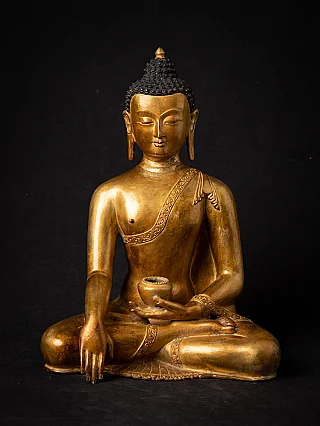
Gift yourself a Buddha statue for Meditation
Motives

The motifs of the opium weights physically appear like a coin in which an animal stands. Mostly these animals are either mythical creatures or real animal which have a mystical meaning. The use of the animals is changed according to the time and the area of use. In often times, the Hintha or Hanthya, and Karaweik are used. Hintha is a mythical duck or goose which is also regarded as the Burmese form of the Garuda. Karaweik is the mythical crane. Another weight is carved in Toe or Tosi which is a lion-like mythical creature. This figure has a face of a lion, horn a cattle, and hooves and tail of a horse.
It is believed that the motifs are the most valuable weight in ancient period. These motives are constructed through the different animals. Some of the notable animal figures are as follows: Naga snakes, dragons, elephants, water buffalo , fish, horses, rats, monkeys, tigers, goats, and dogs. In addition to these figures, there are mass bodies with non-animal motifs, like pagoda or drum weights. It is recorded that the masses above 20 Tical have a semicircular handle that connects the head and tail of the figure.
While molding the weights, first these were hand molded from wax in a lost wax cast. Around 1 viss bronze and 10 Tical wax were used to cast. Later with the objective to softened the weight, scraping material was used in the base or by attaching metal threads. The pieces of glass or lumps of leads were also used. These lead lumps are often seen between the feet of the animals. In recent weights, we can see the calibration marks in the weights.
Share this page